
You might have seen recordings of space travelers bouncing on the moon. Their developments seem bouncier and lighter than how we continue on The planet, and this is thanks to gravity.
Gravity is “the power by which a planet or other body draws objects toward its middle,” as indicated by NASA. Assuming individuals move diversely on the moon than on The planet, does that mean the moon has no gravity?
Table of Contents
Now is the ideal time to get to know how the moon’s gravitational field functions and answer a few other intriguing inquiries concerning Earth’s close by satellite.
Does the moon have gravity?
Indeed, there is gravity on the moon. The moon has a surface gravity of around 1.62 meters each second squared, as per NASA. In examination, the Earth has a surface gravity of roughly 9.8 meters each second squared.
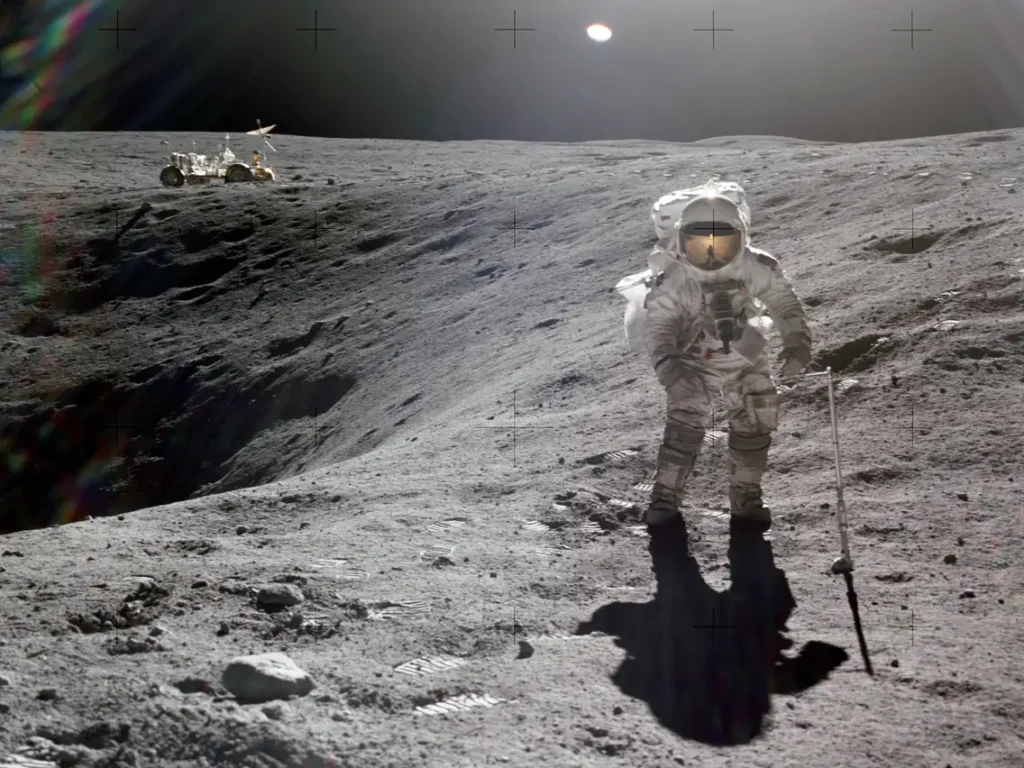
Since the moon’s surface gravity is one-6th of Earth’s, for this reason space explorers’ developments seem bouncier. Weight is influenced by gravity. At the point when the gravitational force is more modest, somebody weighs less.
The moon, be that as it may, has irregularities in its gravitational field due to “Bouguer” gravity oddities. NASA’s Chalice mission estimated these mass irregularities which result from “either varieties in crustal thickness or outside layer or mantle thickness.” Thusly, a few regions on the moon’s surface have more grounded gravity while others have more fragile.
Is the moon a planet?
No, the moon isn’t a planet.
The moon is Earth’s only regular satellite. It circles our planet in a circular way and is the fifth biggest of more than 200 moons in our planetary group, as per NASA.
What is the moon made of?
Perhaps you’ve heard the expression, “the moon is made of green cheddar.” The moon is made of different minerals.
The moon has three layers: center, mantle, and outside.

Its center is “iron-rich,” as indicated by NASA. The mantle is “undoubtedly made of minerals like olivine and pyroxene, which are comprised of magnesium, iron, silicon, and oxygen molecules.” The moon’s outside layer is made of oxygen, silicon, magnesium, iron, calcium and aluminum, as well as modest quantities of titanium, uranium, thorium, potassium and hydrogen.